Products
Seven products. One platform.
Each MachBeat product is a separable revenue line that shares one identity, tenancy and data model — so you can buy Edge and monitoring without seats, or API access on its own, and add the rest as you grow. Status below is honest: what runs today, what’s partial, and what’s planned.
MachBeat Edge
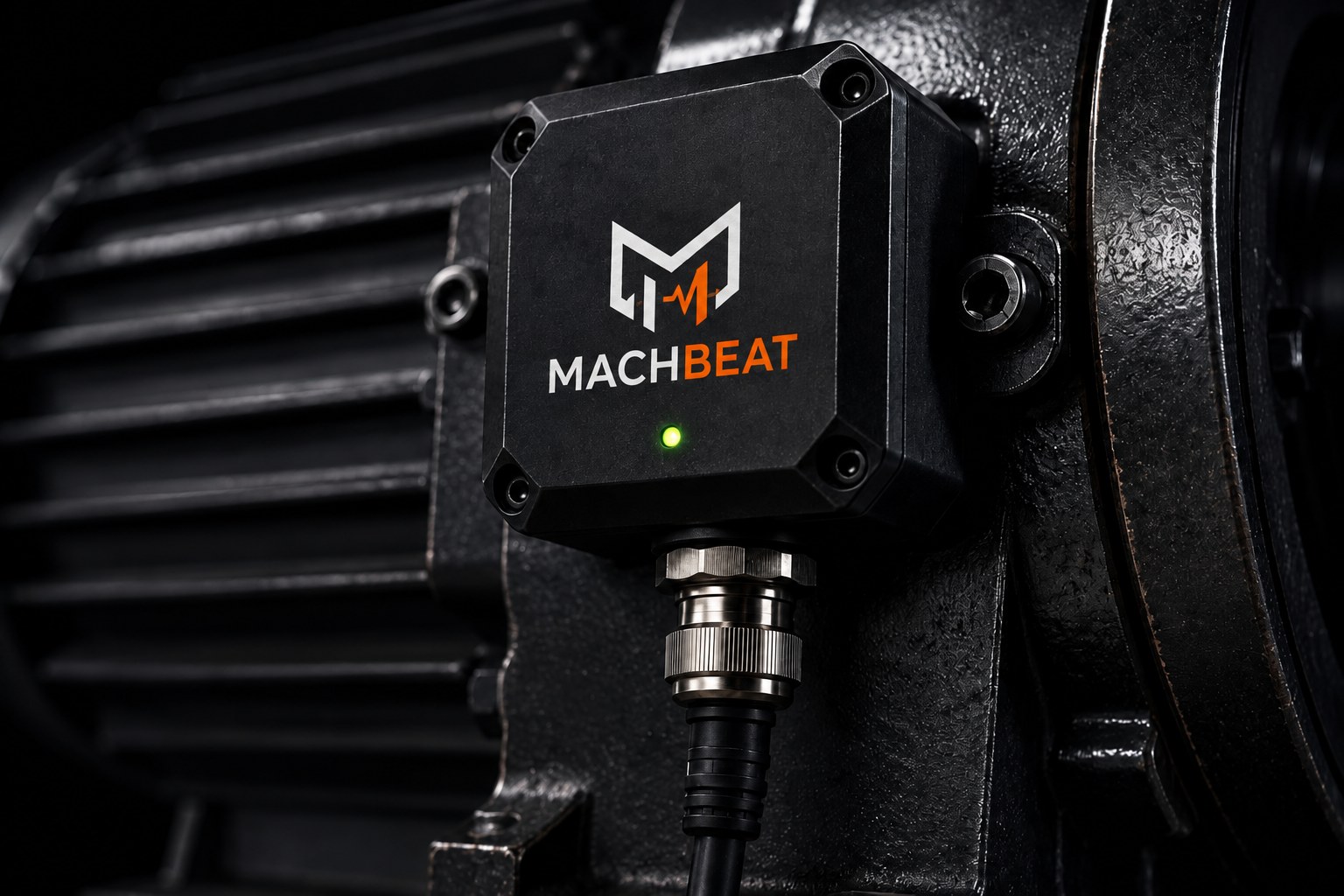
The ESP32-based vibration node running today, evolving into an industrial multi-sensor gateway (RS485/CAN/PoE, DIN-rail, secure boot). It captures condition on the machine and does on-device signal processing and buffering, so nothing depends on your existing infrastructure. Oil-condition sensing is a separate engineering extension that requires application-rated fluid sensors and validation; it is not measured by the current V1 node.
Explore lubricant-monitoring feasibility →
MachBeat Cloud
Device registry, MQTT broker, ingestion, digital-twin state, a time-series store and the API gateway. The core runs today for a single site; the streaming and time-series scale layer that takes it from hundreds to millions of devices is being built.
MachBeat AI
Four detection methods sit in front of the score: engineering limits, a healthy baseline, an operating-condition baseline, and frequency patterns. On each asset the team selects methods and an alert policy. Class or OEM limits, a certified commissioning baseline, and RPM-state ranges run in the product. Envelope, gear mesh, and unsupervised tiers are still ahead. See method status.
MachBeat Vision
The live digital twin of each machine, line and factory. The 2D twin is built into the platform today; an immersive 3D twin is on the roadmap.
MachBeat Insight
Reliability and executive dashboards, KPIs and reports — the mission-control view that is built and running today. This is where a maintenance manager reads fleet health at a glance.
MachBeat Mobile
A native mobile first slice exists for sign-in and core fleet views. Before production use, the app still needs release hardening; offline work-order capture, QR provisioning, photo/voice attachments and push notifications are not yet complete.
MachBeat API
The developer platform provides REST endpoints with Swagger documentation and a limited signed-webhook event set. Native SAP, Maximo and other CMMS/ERP connectors are not included; each integration needs scope, mapping, security review and acceptance testing.
Service parts planning
Demand and inventory for the spare the next job needs. Parts used are stored on the work order. A plant-level forecast of what to hold is scoped with that history. It is not a global demand engine.
Retail inventory
Stock alignment across a dealer or branch network from the issues and sales that customer already records. A live point-of-sale feed is connected only when that feed is part of the agreement.
Service parts pricing
Price guidance from part, asset, and how soon a stop costs more than the spare. The customer’s list stays the source. MachBeat does not set an automatic price on every SKU.
Warranty and service fulfillment
The job, the assignee, and the result stay on the asset. Automated claims, cost recovery, and depot repair routing are a workflow added per program, not a shipped claims desk.
Design principle
Separable revenue lines, one system.
Because every product shares one tenancy and data model, a customer can land with Edge + managed monitoring, then expand into analytics, more seats, or API licensing without a migration. Machine history and commissioned baselines build operational context over time.

Not sure which module to start with?
Most teams start with Edge and monitoring on one critical asset, then expand. Tell us the machine and we’ll recommend the smallest useful footprint.