Home / Platform

The platform

One platform. Sensor to decision.

MachBeat is a single edge-first platform: the sensor node captures condition, the edge and cloud process it, the AI engine explains it, and the apps turn it into planned maintenance. Everything shares one identity, tenancy and data model.

The stack

How data moves from the machine to a decision.

An honest look at the data plane — the parts that run today, and the scale layer we are building as fleets grow.

Edge

Sensor node / gateway

The current V1 reference node captures three-axis vibration and sends readings over Wi-Fi via MQTT. Temperature, oil and other channels need a separately selected, compatible sensor.

↓
Ingest

Broker + workers

MQTT broker and stateless ingestion validate and route every packet.

Store

Time-series + registry

Device registry, tenancy tree and a time-series store for trends and history.

↓
Intelligence

Condition analytics

Signal processing and rules assess machine health, flag deviations, and show evidence for investigation.

Twin

Hot digital-twin state

Current state per machine, fanned out live to the apps.

↓
Apps

Insight · Vision · Mobile · API

Dashboards, the live twin, the engineer app and the developer platform.

Current reference device — V1

ESP32 controller + ADXL345 accelerometer. The current node samples three-axis vibration at a configured rate up to 800 Hz, derives RMS, peak, peak-to-peak and crest factor, and sends identified readings over Wi-Fi via MQTT. The platform exposes REST/HTTPS paths for integration, and the node can buffer packets during brief connectivity interruptions. Current hardware is vibration-only: it does not measure oil, temperature, RPM, pressure, flow or electrical current.

MachBeat software + CMMS

The platform provides device and machine records, telemetry ingestion, time-series readings, status and trends, alerts, and a REST API. The CMMS holds assets, work orders, assignments, schedules, procedures, safety permits, spare-part records, parts used, labour/downtime, and completion notes. Stock and supplier records support operations; this is not a full purchasing department or finance ledger.

Site-engineered extensions

Additional sensors, industrial interfaces, gateways, oil-condition channels, customer-specific thresholds, and ERP or third-party CMMS connectors require compatibility review, hardware/software engineering, commissioning, and acceptance testing. These are scoped extensions, not capabilities claimed for the current V1 unit.

Scale layer (durable streaming buffer, windowed AI, time-series rollups, autoscaling) is on the roadmap — see Resources.
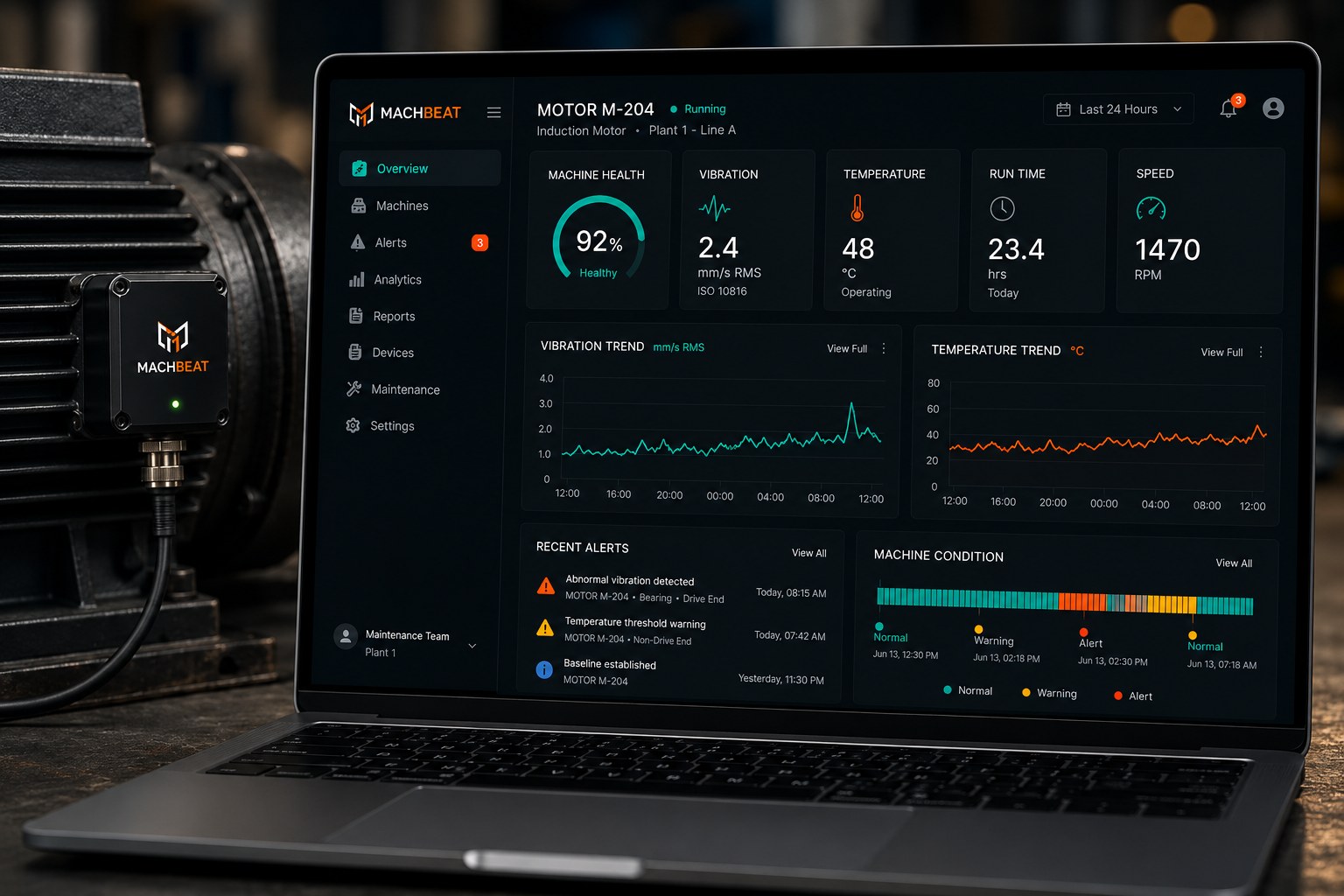
The complete operating model

From a machine signal to verified maintenance.

MachBeat is designed to connect machine evidence with the people and systems that act on it. Each step has a clear owner; an alert does not automatically diagnose a fault or place an order.

01

Sense the asset

Pair a machine and measurement point with a selected sensor. V1 is vibration-only; other channels are engineered to the asset and installation.

02

Transmit & retain

The edge identifies and timestamps readings, buffers brief network interruptions, and sends telemetry to the platform through the agreed site connection.

03

Review condition

View trends, configured rules and alert evidence against machine context. A qualified person checks data quality, operating state and the equipment before deciding what to do.

04

Plan the work in CMMS

Record the finding, create and assign an inspection or maintenance work order, set priority and due date, and attach procedures, permits, skills and required parts.

05

Coordinate parts & procurement

Check and reserve usable stock first. If short, an ERP purchase requisition is an internal request; approvals and sourcing follow company policy. A purchase order is the formal supplier order. The ERP records receipt and typically matches the invoice to the order and receipt before payment.

06

Complete & verify

Record actual parts, labour, downtime, cause and completion notes. Re-measure or inspect the asset, confirm the result, and update its maintenance history and baseline.

Sensor choices

Choose a sensor to answer a maintenance question.

Vibration can reveal changing rotating-machine behavior. Temperature, RPM, motor current/power, pressure, flow, tank level and filter differential pressure add context when the asset requires them. For lubrication, moisture/water saturation and particle cleanliness can be trended; viscosity and temperature need careful interpretation. Density alone does not establish oil health. Chemistry and wear metals may require laboratory analysis.

Sensor range, mounting, fluid compatibility, interfaces, calibration, safety rating and alarm limits must be validated for the site and OEM guidance.

Clear system boundary

CMMS manages maintenance. ERP governs purchasing.

The CMMS manages assets, work orders, schedules, maintenance procedures, parts used, labour, downtime and close-out. ERP typically remains authoritative for stock valuation, supplier terms, approvals, purchase-order release, goods receipt and finance. MachBeat provides condition context and maintenance demand; connectors are scoped and tested with the customer, not assumed to be live.

Explore oil and lubrication monitoring →   See maintenance parts planning →

Prove it in a pilot

Start with one representative asset.

Agree the sensor question, safe installation, operating context, baseline and alert-review owner. Validate readings against inspections, maintenance observations and oil samples where relevant before expanding the configuration.

Measure the outcome

Track useful operational evidence.

Review data completeness, device uptime, time from alert to review, alert confirmation, parts availability at job start, repeat faults and maintenance downtime or cost where a reliable baseline exists. Set acceptance criteria with the customer before the pilot.

Plan a controlled pilot →

The current V1 and site-engineered extensions are distinguished above; additional channels and connectors are planned only after compatibility review, commissioning, and acceptance testing.

Why edge-first

The intelligence belongs on the machine.

Most predictive platforms are software that assumes you already have a historian full of sensor data. MachBeat ships the sensor and the edge intelligence together, so a new install is useful on day one — no integration project, no waiting for months of history.

Owning the edge also changes the economics: value comes from both the hardware and the recurring monitoring, which is how the platform can target a 3–5× lower per-asset cost than cloud-centric incumbents and reach the SME fleets they ignore.

  • No dependence on an existing historian or SCADA export
  • Diagnostics that work cold-start, before failure history exists
  • Lower cost of entry — start with one line, expand by factory
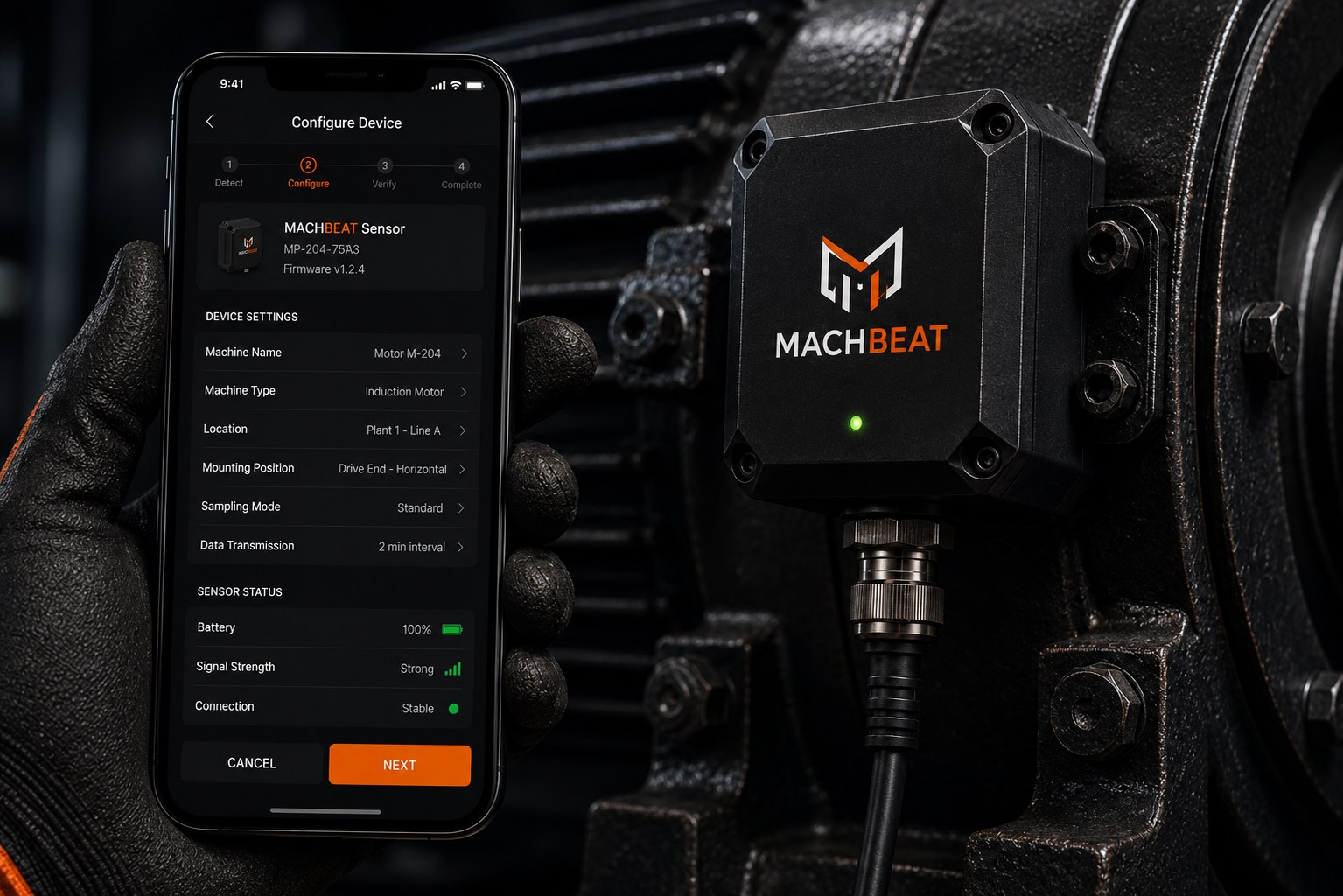
MachBeat edge sensor mounted on a motor, configured from the mobile app

The AI engine

Transparent signals for maintenance teams.

Today the engine combines engineering thresholds, recent statistical baselines, and frequency features where telemetry supports them. Results are rule-based investigative cues; trained machine-learning forecasts are not available yet.

L0
Rule-based diagnosticsRMS, peak, crest, kurtosis, threshold bands, health indicators and explainable evidence
NeedsValid readings and configured thresholds
Rules built
L1
Frequency analysisFFT features and bearing-frequency checks when the sample window and machine context support them
NeedsUsable signal window and machine context
FFT features built
L2
Unsupervised MLIsolation Forest, PCA residual, autoencoder anomaly — no failure history
NeedsWeeks of data
Roadmap
L3
Supervised + deepFailure classifier, LSTM / Transformer RUL, survival models
NeedsRun-to-failure labels
Roadmap

Detection methods

Choose the methods. The platform decides if they may run.

A new asset can use more than one method. MachBeat still checks machine type, sensor capability, sampling quality, and operating context before a method is allowed to raise an alert. The four methods answer different questions. They are not blended into a single average.

01

Engineering limits

Warning, alarm, and trip from power, foundation, and machine type, or from an OEM limit when one is entered. If those are missing, an explicit tenant profile can be used and is labeled as such. The example bands 2.8 / 4.5 / 7.1 mm/s are not applied as a class limit.

Class guidance, not the full standard
02

Healthy baseline

The machine’s own normal range, captured after someone confirms it is healthy. The dashboard asks for that declaration, removes stoppage and saturated samples, stores median and percentile ranges, and waits for an approval before the label becomes certified. “Not sure” stays a reference baseline.

Declaration and approval
03

Operating condition

Is 2.0 mm/s normal at this RPM and load, or only at another speed? The product stores a healthy range per speed state and compares the live value with the expected level at that RPM. Load is included when current or pressure is present. Startup and shutdown are not separate states yet.

RPM states built
04

Frequency patterns

FFT, rotational orders, and bearing frequencies when geometry and speed are known. Envelope, sidebands, and gear mesh come next. This method stays off unless the sample rate and frequency resolution are good enough for that asset. It is not on by default.

FFT + bearing built

Alert policy

Agreement, not an average.

Each method returns its own status, score, confidence, and evidence. Condition severity (normal, watch, warning, high, critical, unknown) is separate from how sure the model is (low, medium, high).

The policy is stored on the asset. Safety-first and conservative require agreement before a warning. A critical engineering limit still alarms on its own. The health score remains on the machine page as a separate summary.

  • Safety-first. A critical engineering limit alarms immediately.
  • Conservative. Two methods must agree before a warning.
  • Sensitive. One strong method can raise a warning.
  • Expert. Weights are set by hand. A critical limit still overrides them.
  • One weak hit stays an informational event.

Commissioning — how healthy data is captured and approved — is described on Solutions. The full checklist is in the product notes, not claimed as shipped.

HR

Built for the enterprise tree

Access follows the real hierarchy — Org → Region → Factory → Building → Line → Machine → Sensor — with health rollups, alerts and permissions at every level. Role-based access is enforced at a single scope choke-point that extends to node-level control.

Enterprise identity (SSO via OIDC/SAML, SCIM provisioning) is on the roadmap for procurement.

SC

Security on an honest path

Today: Argon2 password hashing, JWT with rotating refresh, role-based access and a per-mutation audit log are built. In progress: TLS everywhere and per-device X.509 certificates to replace shared credentials. Planned: signed OTA, and a mapped path to SOC 2 Type II and ISO 27001 before the first Fortune-500 logo.

See the whole platform on one machine.

The fastest way to understand MachBeat is to watch it read a real asset. Pick a critical motor, pump or compressor and we’ll start there.

Start with one machine · no obligation